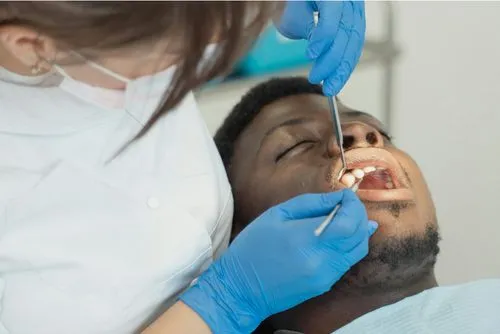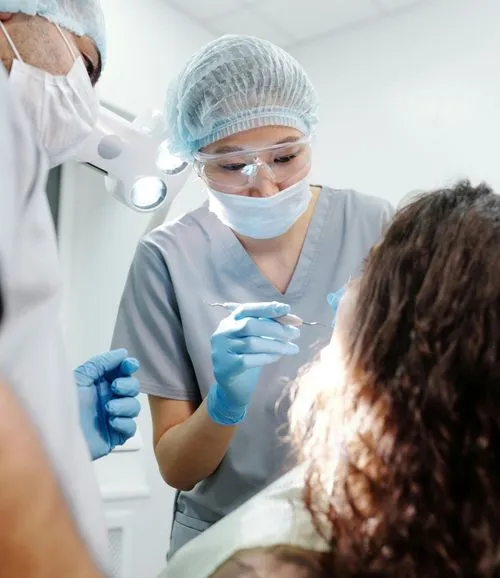
Root canal treatment is necessary when the dental pulp becomes inflamed, which usually manifests as a throbbing pain. While in the past the only option was often to extract the tooth, today the affected tooth can usually be treated effectively and preserved for a long time. We have put together a clear overview of what is required and how a root canal treatment is performed in our practice. Please feel free to contact us if you have any questions or would like to schedule an appointment.
For a root canal treatment to achieve its goal—saving the tooth—three important and interrelated factors are essential:
1. Rubber dam: Protection against bacteria and swallowing
With every root canal treatment, there is a risk that saliva and bacteria could enter the opened tooth and cause an additional infection. There is also the possibility of swallowing parts of the disinfectant solution or other materials.
To minimize these risks, we use a rubber dam. This thin, flexible sheet of latex or silicone is placed over the teeth, leaving only the tooth being treated and the adjacent teeth visible. The rest of the oral cavity is completely shielded.
2. Surgical microscope: High magnification for optimal visibility
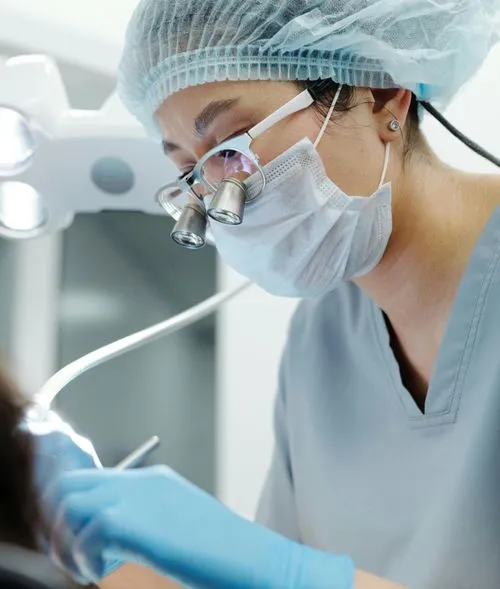
The naked eye cannot capture all the fine details: sometimes the root canal entrances are very small, or the canals themselves are hair-thin, curved, or highly branched.
The surgical microscope makes the hidden visible. High magnification allows root canals to be located more easily and cleaned more thoroughly. Combined with the necessary experience, which is equally important for this treatment, the chances of success are maximized.
3. Ultrasound: Improved detection and cleaning
In addition to the surgical microscope, we have ultrasound at our disposal. Sometimes root canals are calcified, making them barely visible and difficult to access. Ultrasound makes it easier to locate the root entrances by breaking down the calcifications. We also use ultrasound to activate our irrigation solutions, allowing them to reach and clean even the fine lateral canals. Ultrasound is also a great help when removing root posts or broken instruments from the root canal.
4. Electronic length measurement for higher success rates
To ensure that all bacteria and tissue remnants are removed from the root canals, they must be cleaned completely along their entire length. For this, we rely on electronic root length measurement, which allows us to precisely measure every single root canal. This also allows us to reduce the number of X-rays required.
5. Mechanical preparation: Cleaning along the entire length
We perform root canal treatment using motor-driven, extremely flexible files. These adapt to even fine and highly curved root canals without getting stuck and compromising the treatment. These instruments also have a significantly lower risk of breakage compared to conventional hand instruments, which increases safety and contributes to the success of the treatment.
6. Thorough disinfection with irrigation solutions and laser
Despite mechanical preparation, tissue remnants and bacteria can still remain in the tooth. To prevent renewed inflammation, we follow up with a multi-step irrigation process using disinfectant solutions. These are heated to make them even more effective. We also use a laser, as our goal is to achieve 100% sterility.
7. Bacteria-tight filling of the root canals
For the treatment to be successful, it is essential that no cavities remain in the tooth, as these could otherwise become breeding grounds for bacteria. We therefore carefully fill the root canals along their entire length with a thermoplastic root filling. This also tightly seals all lateral canals.
8. X-ray check and follow-up care
After placing the root filling, we use an X-ray to verify that all root canals are completely sealed. A high-resolution 3D X-ray provides additional information even in extremely difficult cases and may be necessary if a standard 2D image from different perspectives is insufficient. If needed, we can make adjustments to the tooth before it is permanently sealed.
9. Bacteria-proof sealing of the canal entrances
The root entrances are also tightly sealed to prevent any further bacteria from entering the tooth. Instead of conventional dental cement or standard plastic, we use high-quality composite (a ceramic-reinforced plastic). This is inserted using a special bonding technique ("dentin adhesive") to create a bacteria-proof seal for the tooth.
10. Restoration of the tooth
Teeth that require root canal treatment often already show significant damage. To ensure they can still be crowned, they must be prepared accordingly. We need to build them up and create a stable core. For this, we also rely on composite. If necessary, we can additionally use glass fiber posts to stabilize the tooth.
11. Restoration with a crown for long-term preservation
Finally, the root-treated tooth is restored with a crown. It covers the tooth like a protective cap and helps ensure it lasts for a long time.
Seit 2009 sorgen wir in unserer Zahnarztpraxis in Idar-Oberstein für Ihr Lächeln